Sleep paralysis
I'm Thinking of Ending ThingsSleep paralysis is presented both as a condition Jake’s mother can name and describe from experience and as a frightening possibility echoed by the Narrator’s nighttime episodes. The parallel is suggestive rather than conclusive: the Narrator reports waking unable to move while sensing a watcher nearby, but the text does not say that she has been diagnosed with sleep paralysis. Instead, it places her vulnerable, uncertain experience beside Jake’s mother’s explicit account of being conscious and immobilized.
Definition and Personal Experience
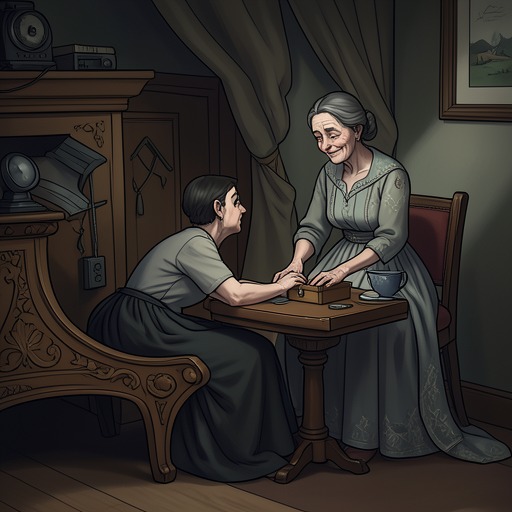
At dinner, Jake’s mother identifies sleep paralysis as a serious, debilitating condition. She describes remaining conscious while unable to move, and adds that an episode can bring a heavy weight on her chest and make breathing difficult. Her account makes the condition more than a label: it is a bodily experience in which awareness persists even as the ordinary ability to act is suspended.
The Narrator’s own episodes begin after The Caller starts calling repeatedly, often in the middle of the night and from the Narrator’s number. She reports nightmares and two panic-filled awakenings, experiences she says had never happened before. In the half-awake state, she feels that someone is in her apartment, standing close by in a corner and watching. The presence seems real enough to frighten her, and she cannot move. The account shares the defining features of conscious immobility and perceived presence, but the Narrator does not name it as sleep paralysis; the connection remains an echo across two accounts, not a confirmed diagnosis.
The Nighttime Episodes
The episodes have a short but intense course. After about a minute, the Narrator fully wakes and goes to the bathroom. In the apartment’s quiet, the running sink sounds unusually loud. Her heart pounds, she is soaked with sweat, and on one occasion she changes out of wet pajamas. She describes feeling more on edge than usual, but considers it too late to tell Jake what has happened. The physical aftermath continues after the immobility ends: waking restores movement without immediately restoring calm.
The Caller’s calls give this fear a recurring context without establishing its cause. Once, while Jake and the Narrator are watching a movie in bed, the Narrator’s number appears on the phone. She passes it to Jake without explaining, pretending to chew; he answers and dismisses the call as an old woman dialing the wrong number. They resume the movie, though the Narrator sleeps poorly that night. On another night, The Caller makes twelve calls while she sleeps and leaves no message. The repeated calls and the episodes are linked in the Narrator’s account by timing, but the text does not establish that the calls produce the paralysis-like sensations or that the presence she senses is physically there.
Jake’s Mother and the Witnessed Episodes
Jake’s mother’s description is accompanied by Jake’s father’s account of what he sees. He says that he sometimes wakes in the middle of the night, turns toward her, and finds her lying on her back, perfectly still, with her eyes wide open and an expression of terror. He says the sight frightens him and that he has never become accustomed to it. His perspective adds an observer to an experience otherwise described from within: her immobility is visible to him, while her conscious awareness and the weight on her chest are conveyed by her own report.
The dinner scene also shows how difficult it is for the family to remain with this subject. Jake’s father gestures with his fork as he describes seeing his wife, then returns to his food. When the Narrator’s phone beeps with a long message, Jake drops his fork and stops eating, staring at his plate. The scene does not explain his reaction, but the interruption places an incoming message beside the conversation about nocturnal vulnerability, and shifts the room from discussion toward silence.
Narrative Significance
Sleep paralysis connects intimate bodily fear to the novel’s wider atmosphere of being watched. In the Narrator’s account, the sensed figure appears at the edge of waking, when she cannot move or verify what she perceives. Jake’s mother supplies a parallel that is more explicitly named and shared with another person: her husband sees her stillness, even though he cannot experience what she feels. Neither account resolves the uncertainty between sensation and external threat. The condition instead gives physical form to a recurring predicament: awareness remains active while the body cannot respond.
The contrast between the two accounts matters. Jake’s mother speaks directly about a recognized condition and its bodily symptoms; the Narrator describes unprecedented panic after the calls begin, without receiving a diagnosis in these passages. Her pounding heart, sweat-soaked pajamas, and eventual movement to the bathroom record the return from the episode in concrete actions, while the calls leave their origin unresolved. Sleep paralysis therefore functions as a point of comparison, not a single explanation for every frightening sensation: it makes the Narrator’s experience legible without dispelling its uncertainty.